Telescope Making Resources in South Africa
This is a list of telescope making suppliers in South Africa which I have come across.
Abrasives
Abrasives are used in the first place to grind the necessary depth of curve into the mirror's face with coarse abrasives. After that finer and finer abrasives are used to remove the marks left by the previous coarser abrasive. Two types of abrasives are normally used by amateurs namely silicon carbide and aluminium oxide. Silicon carbide is harder than aluminium oxide and cuts faster but it is more expensive.
The grades that are normally used for mirror grinding are: P80, P120, P220 en P400. Then also finer grades like 12 and 9 micron aluminium oxide. Earlier I bought my abrasives at Colbern Abrasives but since then they have moved or ceased to exist. I found a new supplier Cape Diamond Tools & Abrasives.1 Exactly which grades they sell I currently do not know since I had only bought P36 from them. They are at least willing to sell any amount. Colbern's minimum amount was 1 kg and most other places do not want to sell less than 25 kg.
Since I could not obtain the finer 12 and 9 micron aluminium oxide grades from Colbern I imported it from Willman-Bell.2
Aluminium
Aluminium poles vir the truss of the telescope tube can be bought at Stalcor.[3] One can use round or square poles. The advantage of square poles is that they are more stiff than round ones for the same diameter. They are also easier to mount.
Aluminizing and Silvering of Telescope Mirrors
Glass without a coating reflects only about 4% of the incident light. In order to raise the reflectance we need a very thin layer of reflective material which will form the actual mirror. The glass being just the support for it. Silver or aluminium is normally used for amateur telescope mirrors. These days aluminium is mostly used. Although aluminium only reflects about 88% of the light as opposed to the 96% of silver it keeps better over the long run. A good aluminium film can stay good for up to 5 years depending on the climate it is used in. Silver oxidizes unfortunately with time with the result that the reflectance of silver diminishes with time. One can however apply a thin layer of lacquer to the silver which will prevent the oxidation.
Aluminizing of telescope mirrors up to 33 cm can be done at the Cape Town Observatory for no cost. But since it has to be fitted in between official work there is no guarantee when the mirror will be aluminized. Normally there is a aluminizing run every few months depending on the number of mirrors that needs to be done and the work load. Mirrors bigger than 33 cm is aluminized at Sutherland and in that case there is cost associated with it. In November 2008 the cost was R865. The mirror must be packed in a sturdy crate to prevent damage to the mirror. The person to contact at the Cape Town Observatory is Malcolm Hendricks.
Aluminizing of mirrors can also be done at Metglo[4] and the person to contact there is Danie Rossouw. Their actual business is the aluminizing of car headlamps. Thus their aluminizing of telescope mirrors is a side business and on an amateur level. I have seen that my 41 cm mirror was not placed square with the aluminium wires which can cause astigmatism in the mirror since the nearer side to the wires will receive a thicker coat. Such finer points are overlooked. I had my 41 cm mirror done there but was not at all satisfied with the results. The mirror was full of curved scratch marks as would be caused by a dirty cleaning rag. I cannot prove that they have scratched my mirror but be warned. It is not nice to spend many hours on a mirror just to have it destroyed by the aluminizing. In order to remove such scratches one has to go back to fine grinding and do all the polishing and figuring all over again. If one wants to use them I would advise to make an appointment with Danie as to when the mirror will be done and then take the mirror to them. Do not give the mirror to them. Be present when the mirror is aluminized and take your own clean rags to clean the mirror with. May be I was just the unlucky one that the rag was dirty when used but I am not going to take that chance again. Their vacuum tank is big enough to do a 80 cm mirror. For the bigger mirrors one would have to make a clamp to hang the mirror inside the chamber with.
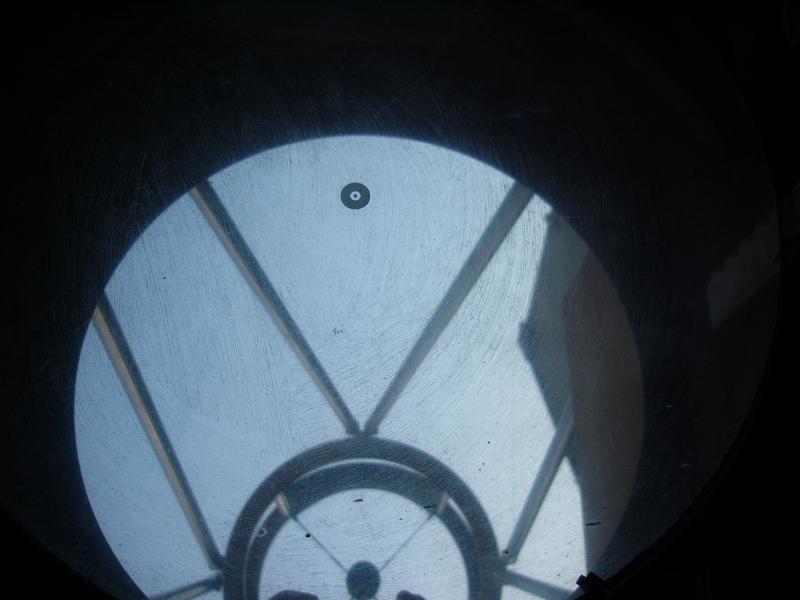 |
Here is a photo of the scratches on the mirror. If it existed before the aluminizing I would have definitely seen them. The scratches are bowed like one would expect from the scratches caused by a dirty rag. Click on the thumbnail. |
A third option is to silver the mirror yourself. See Telescope Mirror Silvering.
Eyepieces
Eyepieces are used to magnify the image formed by the main mirror. One can build your own eyepieces but the problem is that one loses 4% of the light at every surface of the lens. With a 2 element lens one loses about 16% of the light. In order to reduce that to a fraction of a percent the lens surfaces has to be coated with a special layer with the correct thickness. Eyepieces can be bought at Telescope SA[5]
Glass
Two kinds of glass is normally used for amateur telescope mirrors namely Plate glass and Pyrex. The glass is specially annealed to remove the stresses caused by the casting and rolling of the glass. Currently I am not aware of annealed Plate glass or Pyrex glass for telescope mirrors available in South Africa. It will have to be imported.
Plate glass up to 25 mm thick can be bought at PG Glass.[6] The glass will not be fine annealed as required for telescope mirrors and therefore it might contain harmfull stress which might cause the mirror to loose it's shape over time. However I have made a successfull 41 cm mirror from that type of glass. If you decide to use the glass order it square and cut the mirror out yourself. The machine that PG Glass uses to cut round glass disks does not cut it round enough for a telescope mirror. A second more serious problem is that the machine cuts the glass not square but at an angle which causes problems with the support of the mirror. If the mirror sides are not square the mirror tends to move away from it's supports causing the mirror to bend with resulting astigmatism in the mirror.
Plate glass up to 19 mm thick can be bought at RSG Products[7]. A piece of 335 x 335 x 19 mm costs R180 (2009).
Pitch
Pitch is used as the base to carry the polishing compound and to follow the changes of the mirror's figure during polishing and figuring. The pitch that is normally used by amateurs for the making of telescope mirror is made from the gum of pine trees. The pitch is made by heating the gum in the absence of air. So far as I know there is no suppliers of this type of pitch in South Africa. In place of it we use Bitumen which is made from tar.
Resources of small amounts of bitumen is a problem. The only place I could find was A B E Construction Chemicals:[8]. The smallest amount they are willing to sell is 40 kg which is hopelessly too much. Buy the 90/120 type. Another possibility is to ask at businesses that do roof sealing. They may be willing to sell a kilogram or so. Such bitumen might be contaminated and it would be advisable to strain it through a double layer of cheese cloth after melting. If there is any dust or sand in the bitumen it could scratch the mirror.
Polishing compound
Polishing compound is firstly used to remove the pits left by the fine grinding and secondly to figure the mirror into the desired figure.
Silvering chemicals
Chemicals for silvering the mirror can be bought at N.T. Laboratory Supplies.[9]
Apparently N.T. Laboratory Supplies is no longer in Epping. DynaChem[10] in the same road has all the chemicals except the silver nitrate.
A possible source is Clean Safe[11].
Suppliers
Disclaimer: I have no arrangement with any of the suppliers.
1. Cape Diamond Tools & Abrasives: Dawn straat 1, Montague Gardens, Cape Town. Tel 021-555 1290. Fax 021-555 1299. See also Cromwell.
2. Willman-Bell
3. Stalcor: Bosfor Sirkel 87, Epping Industria, Kaapstad. Tel 021-5079600. Faks 021-535 2370.
4. Metglo Metallizing CC: Patrys Circle, Brakenfell, Cape Town. Tel 021-981 9802. Fax 021-981 9804.
5. Telescope SA: Tel 082 823 7384.
6. PG Glass: Buitengracht street 88, Cape Town. Tel 021-24 4520.
7. RSG Products: Manhattan Road, Airport Industria 2, Cape Town. Tel 021 386 1370. Fax 021 386 1784.
8. A B E Construction Chemicals Benbow Lane 18, Epping Industria, Cape Town. Tel 021-54 1341.
9. N.T. Laboratory Supplies: Unit 6, Denval Industriële Park, Fisher Laan, Epping Industria, Cape Town. Tel 021-535 1810. Fax 021-535 1627.
10. DynaChem. No. 7 Fisher Avenue Epping 1, Cape Town. Tel 021-5346363. Fax. 021-534636.
11. Clean Safe.